
On Tuesday, June 16, the Miami-Dade County Commission approved the operating plan for the Miami Center for Mental Health and Recovery, and the vote was unanimous. After twenty-two years, the doors are going to open. We are overjoyed, and we are thinking of our neighbors who will walk through them.
In America, the largest providers of mental health care are jails. Here in South Florida, the Miami-Dade County jail functions as the largest psychiatric institution in the state, and on any given day more than a thousand people living with mental illness sit in those cells. The vote on June 16th was the start of a different answer.
We have written before about how this community is working to change that: Miami’s vision of hope, the county’s long history of turning pain into purpose, and our recent #FlawlessTalk with Judge Steve Leifman. Today we want to stay inside a single building, drawing on a behind-the-scenes tour we took of the Miami Center for Mental Health and Recovery.
The center rises seven stories inside a renovated former state forensic hospital between Wynwood and Allapattah. It is the fulfillment of a promise Miami-Dade voters made in 2004 when they approved the money to build it. After a $51 million renovation, the 181,000-square-foot facility now holds 208 beds and an entire continuum of care under one roof: intake and assessment, crisis stabilization, residential and outpatient treatment, medical, dental, and vision care, transitional housing and housing placement, day programs, job-skills training, onsite legal and social services, and a courtroom.
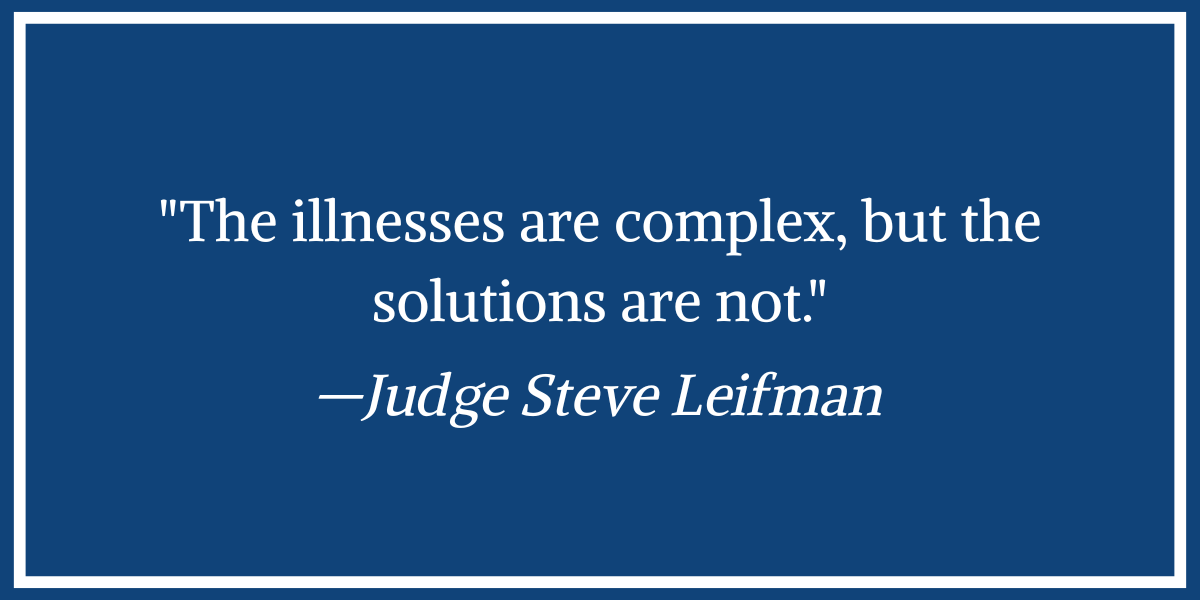
The county built the center for a specific population. As Judge Leifman shared with us, over a recent five-year span, 16,400 people on Miami-Dade’s diversion-eligible list spent 1.2 million days in jail at a cost of $414 million, and the thousand people who cycle through most often cost taxpayers $117 million on their own. Those thousand neighbors, the ones every other system has given up on, are exactly who this center was built to embrace. As Judge Leifman once put it, “The illnesses are complex, but the solutions are not.”
What We Saw When We Walked Through the Doors
The first thing that struck us was what was missing. Gone was the architecture of fear and confinement that care for this population once took for granted. The reception area felt like a living room. The message to our team was clear: a person arriving in the worst hours of their life is received as a guest, not processed as an inmate.
When our hosts walked us through the center’s history, they described how a team of designers traveled across New York for inspiration, visiting some of the city’s top hotels to learn how to make the space warm, inviting, and comfortable. They succeeded. The colors are neutral and calming, with whites, beiges, and soft tones shown to support recovery.
That palette carries throughout. Upstairs, the crisis stabilization and residential floors are bright and calm, with natural light pouring into spaces built for rest and recovery rather than confinement. Outdoors, a gazebo and a calming garden give participants a place to enjoy the open air while they focus on healing.
We also stood in the courtroom, an actual courtroom inside a treatment center, and thought about how much changes when a judge can walk a person from a hearing straight into care instead of back to a cell. The on-site court carries a practical benefit too. Proceedings such as the Marchman or Baker Act can happen in the building, so people receive care the moment they need it, without the usual bureaucratic delays.
The details that moved us most were the human ones. There is a dental suite and a vision clinic, because so many of this community who are unhoused have not seen a dentist or worn glasses in years. There is a hair salon, a barber shop, and tattoo-removal services, because dignity and personal preference are part of care. There are classrooms and training spaces where people will build job skills. The center is designed to do more than heal. It is built to send people back into the world equipped to live their most meaningful lives.
And then there was the quiet. On the day we toured, every floor was finished and every light worked. The building had been completed and certified back in 2023, and it was still empty. Walking those pristine hallways, knowing that a few miles away more than a thousand people who belong in those beds were sleeping in jail cells, was the hardest part of the visit. That is the quiet this unanimous vote begins to end.
How Miami Compares to the Nation’s Best
To understand why this center matters, it helps to look at the places that pioneered this work. In San Antonio, Bexar County’s Restoration Center operates as a 24-hour, one-stop diversion hub where officers can bring a person in crisis to a unit for detox, or a minor medical clinic instead of a jail cell. Across the street sits Haven for Hope, a $101 million, 22-acre campus where roughly 1,700 people experiencing homelessness sleep each night, with everything from medical care to a barber shop on site. It has become a national pilgrimage site for advocates who are reforming the system.
In Tucson, the Crisis Response Center took a different path, connecting its crisis facility to Banner University Medical Center so that psychiatric emergencies get the same urgency, and the same place, as medical ones. And across the ocean is the north star: Trieste, Italy, whose community-based system, which the World Health Organization recognizes as the world standard for community psychiatry, replaced the asylum with round-the-clock neighborhood care. Judge Leifman has long pointed to Trieste as a model for their work.
Here is what makes Miami different. San Antonio built a brilliant front door, and Tucson built a brilliant emergency room, but in both places the path from crisis to housing to employment still winds through separate buildings, separate agencies, and separate doors, each one a chance for a person to fall through the cracks. The Miami Center puts the entire arc of recovery under one roof, from the first hours of crisis through residential treatment, health care, job training, housing placement, and the courtroom itself. That is why people have called it a first-of-its-kind facility in the world, and why delegations will one day tour Northwest Seventh Avenue the way advocates tour San Antonio and Trieste today.
The Vote Is In
The center has funding lined up for its first years through federal ARPA and opioid-settlement dollars, along with an experienced nonprofit operator ready to run it on a roughly $38 million two-year operating plan. For a long time, the one thing it lacked was a final vote from the Miami-Dade County Commission. This spring, more than 800 faith leaders and residents with PACT filled Corpus Christi Catholic Church to demand the doors open. On June 16, after years of delays, the commission voted yes, and the vote was unanimous. The operating plan is approved, and the operator can now move toward opening the doors.
At Flawless, we believe in seeing the perfection in every person. Twenty-two years ago, Miami-Dade voters made a promise to our most vulnerable neighbors. This week, their leaders kept it. The keys exist, the beds are made, and the will to open the door has arrived.
We will be watching in the months ahead, and we will share updates as the center moves from a finished building toward a fully operating one. If you live in Miami-Dade, thank the commissioners and advocates who carried this across the line, and stay close to the work as it begins. The people who belong in those 208 beds have waited long enough.
We are proud of our continued partnership with the mental health advocacy community in Miami and we cannot wait to see this center come to life.
Watch our recap post of this inspiring moment on social media here: