
Mental Health, the Justice System, and the Miami Center for Mental Health and Recovery
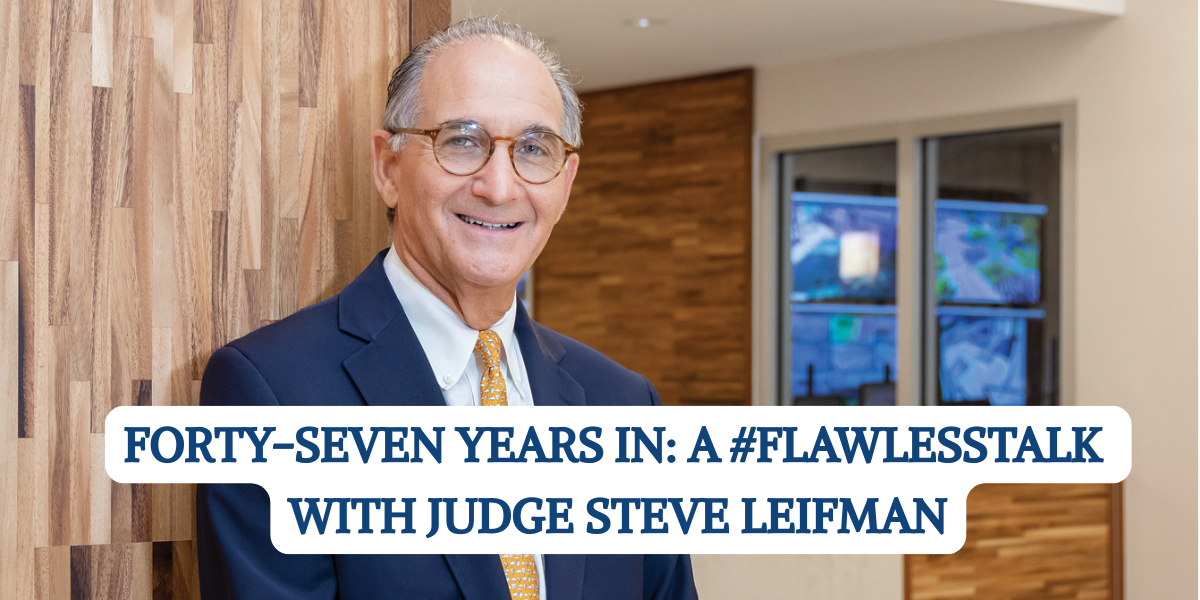
Judge Steve Leifman is a retired Miami-Dade County court judge who continues his advocacy work through the Leifman Group. He sat down with us to talk about what brought him to this work, what Miami has built over the last twenty-five years, and what a more humane system could look like.
Some of the most consequential mental health work in this country is happening in courtrooms, in jail intake centers, and in the offices of judges who decided, somewhere along the way, that the system in front of them was not the system the people in front of them deserved. Judge Steve Leifman is one of those judges.
A Career That Started at Seventeen
Judge Leifman traces his work back to a state hospital visit when he was a seventeen-year-old intern for then-State Senator Bob Graham. He was sent to check on a young man whose parents could not secure his release. What he found was a young man in four-point restraints, misdiagnosed and incorrectly treated by the hospital, who was on the autism spectrum. Later that day, a group of advocates touring the facility insisted he come downstairs with them, where the conditions he witnessed have stayed with him for nearly fifty years.
When the Hospitals Closed and the Jails Filled
When Judge Leifman started as an assistant public defender, one wing of one floor of the Miami-Dade County jail housed people with serious mental illnesses. By the time he was appointed to the bench, three of nine floors held that population. The turning point came with a case involving a Harvard-educated psychiatrist who had developed late-onset schizophrenia, lived on the streets, and was cycling through the system. After months of detention on a minor offense, evaluations found him incompetent to proceed and imminently dangerous to himself or others. The law still required release back to the street. As the judge told us, “It was absurd.”
That case sent him to the first national meeting on mental health and the justice system in 2000. He came back with a small grant, three national experts, and a two-day summit that produced a written collaborative agreement. What followed has become a model that other cities are now studying and replicating.
What Miami Built
The Miami plan had two parts. Pre-arrest diversion was built around Crisis Intervention Team policing, a forty-hour training program teaching patrol officers how to recognize someone in crisis, de-escalate, and connect people to care instead of custody. Miami-Dade now has the largest trained CIT squad in the country, more than 9,500 officers across all 36 of its police departments. Annual arrests dropped from 118,000 to 53,000. The jail population fell from 7,400 to 4,400. The county closed one of its three main jails at an estimated savings of $239 million.
Post-arrest diversion put mental health professionals in charge of jail screening and connected people who screened positive to a psychiatrist within 24 hours, then to stabilization, then to a peer with lived experience who helped them re-enter the community with housing, medication, and a plan.
Misdemeanor recidivism dropped from 75 percent to 20 percent. Felony recidivism dropped to 6 percent.
If he were starting today, he told us, he would add a third part: trauma screening in elementary schools. Severe trauma is physiological, alters brain activity, and can trigger serious mental illness in those with a predisposition. The intervention belongs upstream in schools and pediatricians’ offices.
The Miami Center for Mental Health and Recovery
The next chapter is a building. The Miami Center for Mental Health and Recovery is finished, beautiful, and waiting to open. Voters approved the bond issue. The county has spent $52 million on construction. Judge Leifman described it as having every essential element of recovery in one location: crisis stabilization, short-term residential care, primary and specialty clinics, a courtroom, supportive employment, and housing for up to 208 people.
“It’s easier to think about these illnesses like cancer,” he told us, “like they’re stage one through stage four.” The country has MD Anderson and Sloan Kettering for stage four cancer. It has nothing comparable for stage four mental illness. “And so people continuously cycle through these deep-end systems. It’s cruel. It’s unfair.”
Over five years, 16,400 people on Miami-Dade’s diversion-eligible list spent 1.2 million days in jail at a cost of $414 million. The top 1,000 of that group cost taxpayers $117 million. That is the population the center is built to serve.
A Flawless World, Through the Lens of Trieste
We closed the conversation where we always do, with the question of what a flawless world would look like. Judge Leifman pointed to Trieste, Italy: a psychiatrist responds to crises instead of a police officer, three case managers support someone around the clock until they stabilize, and the hospital has become a workforce program with a radio station, a restaurant, and a clothing line residents help run. More than the structure, he emphasized the framing.
In Trieste, people are not identified by their illness. You are someone who happens to have an illness.
A Call to Action
The criminalization of mental illness is what happens when the mental health system does not reach someone in time. Brain health is health. If you live in Miami-Dade County, Judge Leifman asked us to share this directly: contact your county commissioner and ask them to approve the operating plan.
We are grateful for his candor and the forty-seven years of advocacy behind a one-hour conversation. We will share updates as the building moves toward the opening for which it was built.