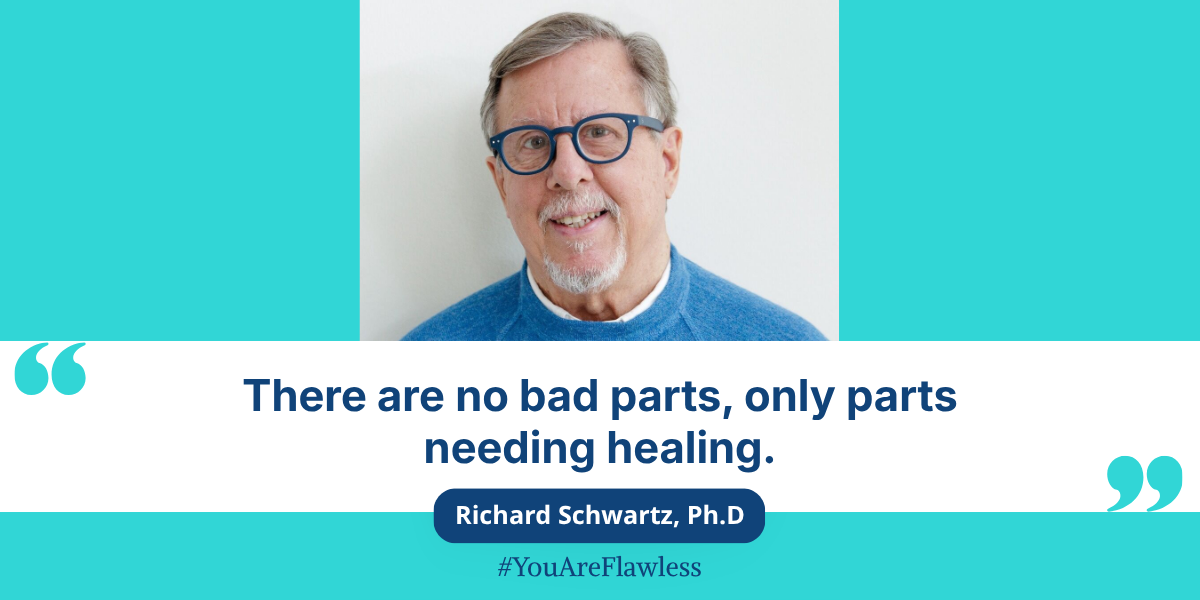
There is an idea at the center of Internal Family Systems therapy that, the first time you hear it, feels almost too gentle to be true. There are no bad parts of you. Not the anxious one. Not the angry one. Not the one that shuts down when life gets heavy. Each of those inner voices took on a job at some point, often very young, because a job needed doing. The work of healing is not to silence them. It is to listen.
This is the framework that Dr. Richard Schwartz has spent nearly four decades developing, and we had the privilege of joining his recent introduction to Internal Family Systems at Oregon Health & Science University’s Psychiatry Grand Rounds. Dr. Schwartz is the founder of the IFS Institute and serves as a Teaching Associate in Psychiatry at Cambridge Health Alliance, a Harvard Medical School affiliate. His lecture offered a clear, accessible entry point into a model that is shifting how clinicians, families, and individuals understand our inner workings.
We left with several takeaways we want to share with our community, because the language and the lens of IFS belong to everyone, not just the therapy office.
We Are Not One Voice. We Are a Whole System.
Most of us are taught to treat conflicting inner voices as a problem. One part of you wants to rest. Another part insists you keep going. One wants to speak up. Another tells you to stay small. The traditional response is to pick a side and try to silence the rest.
Dr. Schwartz challenges that idea. In IFS, the mind is naturally multiple, and that multiplicity is not pathology. It is how human beings are wired. He describes a person’s inner life as a kind of family, with each member playing a role in the larger system. Some parts of us run our daily lives. Some carry the wounds of earlier experiences. Some show up in moments of overwhelm and try, in their own way, to keep us safe.
The Three Kinds of Parts
Dr. Schwartz organizes the inner system into three categories. None of them is bad. All of them are working, in one way or another, to protect the person they live inside.
Managers are the planners. They run our days, set our calendars, push for control, and try to keep painful feelings from breaking through. Managers can show up as perfectionism, people-pleasing, or the quiet inner voice that says, “Don’t go there.” They are working hard, all the time, to keep things steady.
Firefighters are the responders. When pain reaches the surface anyway, firefighters rush in to put it out. They can show up as scrolling, drinking, rage, withdrawal, or anything that numbs the moment quickly. Firefighters often look like the parts we judge most harshly in ourselves. Dr. Schwartz invites us to remember that they took on these jobs because something needed “putting out.”
Exiles are the young, wounded ones. They carry the pain, fear, or shame from earlier experiences that the system was not equipped to feel at the time. Managers and firefighters work overtime to keep exiles out of view, because what exiles carry is heavy. The healing in IFS happens, in large part, when exiles are finally listened to.
Underneath It All, the Self
If parts are the family members, the Self is the wise, steady center that lives in every person. Dr. Schwartz describes the Self as a core of compassion and clarity that remains undamaged by trauma, present in everyone, no matter what they have lived through. You may not feel it on a hard day. That does not mean it is gone. In IFS, when protective parts are running the show, the Self gets covered, not erased.
Dr. Schwartz has named eight qualities that show up when the Self is leading. They are sometimes called the 8 C’s: calm, curiosity, compassion, clarity, courage, confidence, creativity, and connectedness. Notice which ones feel within reach today. Notice which ones feel far away. Both are useful information about which parts are in charge right now.
What If Symptoms Are Strategies?
One of the most powerful shifts in IFS is the way it reframes psychological symptoms. Where traditional language might call a behavior dysfunctional, IFS asks a different question: what is this part trying to protect? Anxiety can be a manager working to prevent harm. Numbing can be a firefighter trying to stop overwhelm. Self-criticism can be a part trying to keep you from a kind of rejection it remembers too well.
This doesn’t mean the symptoms feel good, and it does not replace the support of a qualified clinician. It means the symptoms are not random, and they are not proof of damage. They are strategies a younger version of the system came up with to survive. For families walking alongside a loved one who is struggling, this lens can soften some of the hardest moments. The behavior that looks frustrating from the outside is often a part doing exactly the job it was assigned. The person you love is not their hardest part. They are the whole system.
A Growing Evidence Base
At Flawless Foundation, we believe that brain health is health, and that means leaning on research and the voices of qualified clinicians. IFS has been studied across a range of conditions, and the evidence base continues to build.
In 2015, IFS was added to the federal Substance Abuse and Mental Health Services Administration (SAMHSA) National Registry of Evidence-based Programs and Practices. A 2025 scoping review in Clinical Psychologist identified IFS as a promising approach for PTSD, depression, and chronic pain, while noting that further large-scale studies are still needed to establish the model’s full reach.
As Dr. Schwartz himself has emphasized, the work of replication and rigorous study is ongoing, and the field is still learning. We share these findings not to make sweeping claims, but to point to a body of research that is real, accessible, and worth knowing about.
Why This Lecture Matters to Us
The throughline of Dr. Schwartz’s lecture mapped onto the mission Flawless Foundation has been pursuing for years: brain health work that de-pathologizes, that treats the person as whole, and that takes seriously the idea that inside every struggle is a strategy that once made sense. IFS gives a name and a structure to that intuition. It also gives families a kinder way to talk about the loved ones they are walking alongside.
We left the lecture with one line in our notes, written under everything else: the Self is in everybody. That is the work we try to do, and it is the reason we keep doing it.
We are grateful to Dr. Schwartz and the OSHU Department of Psychiatry for making this session available. If the framework speaks to you and you want to explore it further, the resources below are an accessible place to start.
Further Reading & Resources
Dr. Schwartz’s book No Bad Parts: Healing Trauma and Restoring Wholeness with the Internal Family Systems Model (Sounds True, 2021) is the most accessible introduction to the model for general readers.
The IFS Institute maintains educational resources, training information, and a directory of trained therapists at ifs-institute.com.
To find a qualified mental health provider in your area, the National Alliance on Mental Illness (NAMI) helpline is available at 1-800-950-6264, or visit nami.org. If you or someone you love is in crisis, you can call or text 988 for free, confidential support 24/7.