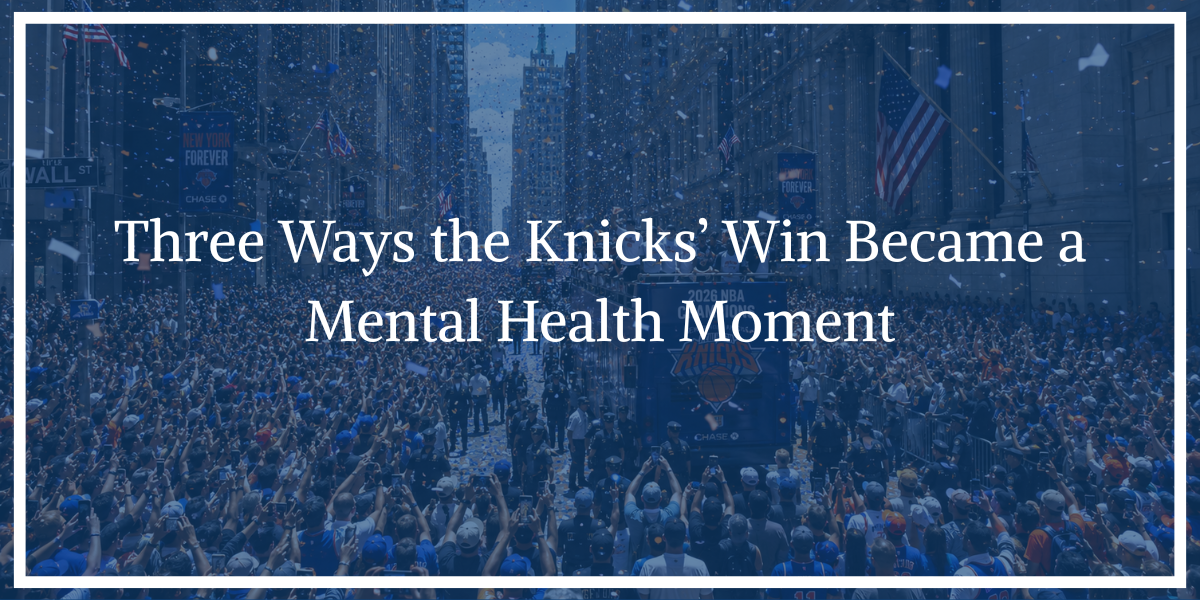
On June 13, the New York Knicks won their first NBA championship in 53 years. Five days later, a crowd estimated in the millions filled Lower Manhattan for a ticker-tape parade down the Canyon of Heroes.
We celebrated alongside the rest of the city, and three moments from the week stayed with us. Each one says something about mental health, and about how people show up for themselves and for each other.
1. The players made space for vulnerability.
A lot of us are taught early to keep the hard stuff to ourselves. Push through. Stay composed. Handle it alone.
That pressure can fall especially hard on men. In the United States, the suicide rate among males is nearly four times the rate among females. So when players at the center of a title run speak openly about mental health or allow themselves to be visibly emotional, it carries weight.
Center Mitchell Robinson did exactly that during the playoffs. He told followers on Snapchat that his mental health was not in a good place and that he was stepping away from social media for a while to reset. There was no apology and no attempt to dress it up. A player in the biggest stretch of his career took a step to protect his mental health and said so plainly.
Finals MVP Jalen Brunson has been just as direct about the mental side of the game. When asked after Game 4 how he deals with doubt in the middle of a high-stakes series, Brunson said players are “allowed to think about the worst possible scenario,” but then have to go out and do something about it. Mental health advocates later noted that his answer mirrors a technique therapists teach for anxiety: name the fear and picture yourself handling it, instead of pretending it is not there.
Then, after Game 5, Brunson shared an emotional embrace with his father and assistant coach, Rick Brunson. It was a reminder that composure and emotion can coexist. Even at the highest level of competition, there is room to feel what a moment means.
2. The city showed up as one.
A championship gives a city a shared story, and this one brought millions of strangers into the same few blocks to feel something together. People who might never otherwise meet stood shoulder to shoulder, hugged, cried, and celebrated.
That togetherness matters. Loneliness is among the biggest risks to mental health, and connection is one of the strongest buffers we have. A parade does not solve loneliness on its own. What it does is remind a city what belonging feels like, and for anyone carrying something heavy in private, being part of a crowd gathered in celebration can offer a real sense of connection.
3. Strangers fought to save one man’s life.
The most powerful moment of the week was not the final buzzer. It came on parade day, on top of a subway entrance near the route, where hundreds of people had climbed onto the scaffolding to catch a glimpse of the team. One of them, a man perched about 30 feet above the street, collapsed from an apparent overdose.
For about 45 seconds, the crowd pointed and recorded. Then Simone Kelly, a 24-year-old volunteer EMT and neuroscience student, jumped off a sanitation truck, ran to the structure, and climbed up. She found him barely breathing, administered naloxone, commonly known by the brand name Narcan, and worked alongside bystanders to help bring him to safety.
Substance use disorders are behavioral health conditions, and an overdose is a medical emergency. Too often, people experiencing either are met with judgment instead of help. At the Knicks’ ticker-tape parade, strangers chose compassionate intervention rather than indifference.
Kelly has since encouraged people to carry naloxone. In New York City, free naloxone is available at participating pharmacies, community organizations, and public-health vending machines.
Any one of us could be the person who calls 911, carries naloxone, or helps someone in crisis stay safe until emergency responders arrive.
What we’re taking from the week.
A basketball title can bring a city together for a day. This one did more than that.
Players spoke honestly about mental health. A city chose connection over isolation. And strangers refused to look away from a neighbor in trouble.
All three moments point to the same truth: people do better when they let one another in.
Congratulations to the Knicks, and to a city that waited 53 years for this. The win was the headline, but the good it set in motion is what will outlast the confetti.
If you or someone you love is struggling, you do not have to wait for a crisis to reach out. Call, text, or chat 988 to connect with the 988 Suicide and Crisis Lifeline. Support is available 24/7, free, and confidential.
If you witness a suspected overdose, call 911 right away. Naloxone, often sold as Narcan, reverses an opioid overdose, is safe and simple for anyone to use and requires no medical training. It is available over the counter at most pharmacies and free through many community organizations and public-health programs. Carrying it is one small way any of us can be ready to save a life.