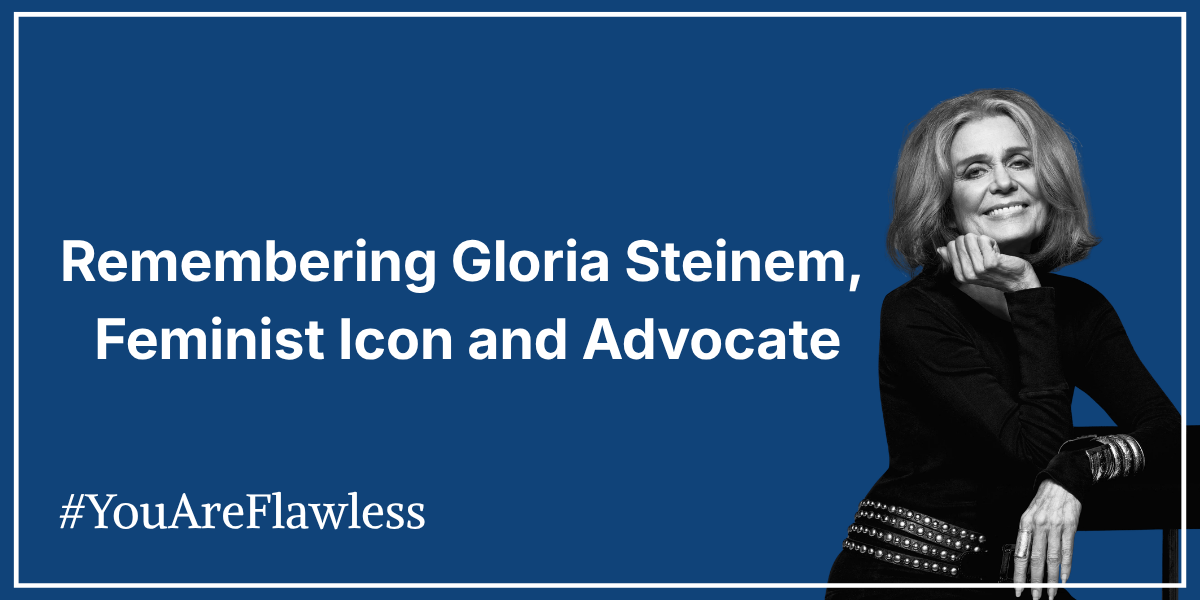
Gloria Steinem died on Wednesday, September 2nd at her home in New York City. She was 92. Her official Instagram account announced her death, saying she passed away “surrounded by some of the many who loved her.”
The world will remember her for the movement she built. She helped launch Ms. magazine and co-founded the National Women’s Political Caucus with Betty Friedan, Bella Abzug, and Shirley Chisholm. For decades, she advocated for women’s rights, and she became one of the most recognized voices in American feminism. That record put her at the center of second-wave feminism and kept her there for the rest of her life.
Fewer people know what came before all of it.
Steinem’s mother, Ruth, lived with severe depression and hallucinations for most of her adult life. Doctors in the 1940s diagnosed her with an “anxiety neurosis” and offered little else. Steinem’s parents separated when she was about ten, and she moved with her mother into a house in East Toledo. The two of them managed the household alone. Steinem cooked and cleaned, and she kept her mother safe on the days Ruth could not leave her bed. She carried that responsibility through most of her childhood.
That kind of caregiving had no name and no support system in the 1940s. Families kept a relative’s mental illness private, if they spoke of it at all. People around her dismissed women’s mental health challenges as nerves or a failure to manage a household. Steinem watched doctors dismiss her mother’s suffering as a personal failing. She carried that memory for decades.
She broke that silence herself. In her 1983 essay “Ruth’s Song (Because She Could Not Sing It),” Steinem wrote about her mother’s condition in detail her generation rarely allowed. She described a woman who had built a career as a journalist and lost it to an illness her doctors dismissed. She carried that recognition into her writing and her organizing for the rest of her life. Women’s psychological health, she argued, deserved the same care doctors gave to any other patient.
At Flawless, we encourage families to talk about brain health the way they talk about any other part of their health. For generations, families kept that kind of story hidden. Families who named a relative’s mental illness faced shame at home and doctors who sent women away without treatment. Gloria Steinem named her mother’s condition anyway. Her generation had no real language for it, and she used her own instead. A lot of families are still learning to say it the way she did.
We send care and condolences to the people who loved her, and to anyone who recognized their own family in her story. Steinem spent decades organizing for women’s rights. She also gave families a way to talk about a parent’s illness out loud, something many of us are still learning to do.
Few people reshape a generation’s expectations. Gloria Steinem did, in the workplace and in politics. She also became a role model for mental health advocacy, sharing her own family’s story when few public figures would. She was a force for change until her passing and we are all living in a more Flawless World because of her extraordinary contributions. Her legacy will live on through the lives she has touched and her work, carried forward by Gloria’s Foundation.