
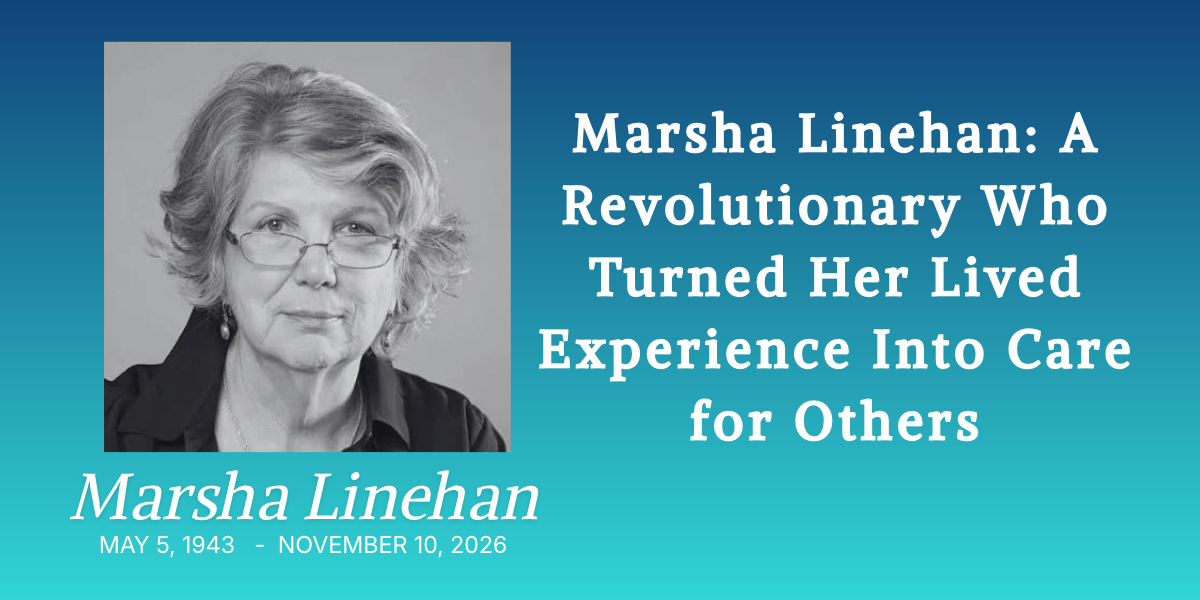
For years, Marsha Linehan’s patients noticed the old scars on her arms, and for years she turned their questions aside. Then one patient pressed her. Had Linehan once struggled the way her patients struggled? If she had, the patient told her, the rest of them would have reason to hope.
Dr. Linehan answered this question in 2011. She returned to Hartford, Connecticut to the psychiatric hospital she had entered as a 17-year-old patient. There, she broke her public silence and described her own hospitalization to an audience of family and doctors. “I cannot die a coward,” she told The New York Times.
Marsha Linehan, a pioneer in mental health care and the founder of Dialectical Behavior Therapy (DBT), died on November 10, 2026. She was 83. She spent her professional life building care for people at high risk of suicide, people many clinicians of her era had dismissed as untreatable.
She was admitted to the Institute of Living in 1961 and stayed more than two years. Doctors there diagnosed her with schizophrenia, kept her in seclusion for long stretches, and treated her with electroconvulsive therapy and strong medication. She harmed herself during her stay, and her wish to die grew stronger. Decades later, she said she believed she had been living with borderline personality disorder, the condition at the center of her life’s work, though her doctors never gave her that diagnosis.
She wrote about those years in her 2020 memoir, Building a Life Worth Living. “I made a vow to God that I would get myself out of hell,” she wrote. She also promised to go back in for others once she got out.
She kept that promise through research. After earning her PhD at Loyola University Chicago in 1971, she joined the University of Washington faculty in 1977 and studied suicidal behavior there until she retired in 2019. Linehan practiced Zen and later became a Zen master, and she carried that practice into her clinic. Behavior therapists of her day asked clients to change. Therapists who use DBT teach two acceptance skills, mindfulness and distress tolerance, alongside two change skills, emotion regulation and interpersonal effectiveness.
Linehan and her colleagues tested the approach in a clinical trial and published the results in 1991. Participants who received DBT were less prone to self-harm and less likely to drop out than people in standard therapy. In 1993 she published two treatment manuals, and she later founded Behavioral Tech to train clinicians in the method. DBT is now considered the gold standard for treating borderline personality disorder, and in 2025 the American Foundation for Suicide Prevention gave her its Lifetime Achievement Award.
She wrote her DBT manual in plain, personal language and left out the jargon. Plenty of people who learned the skills from its pages call her by her first name, as if she were a friend who had walked them through their hardest weeks.
We send our condolences to her daughter, Geri, and to the family and friends who loved her. Clinicians around the world are changing lives with DBT. If you have leaned on the skills of DBT to get through a hard night, you learned them from a woman who knew those nights herself. We are eternally grateful to Marsha Linehan for her revolutionary contributions to our field.
If you or someone you know needs to talk to someone right now, call, text, or chat 988 for a free, confidential conversation with a trained counselor, available 24/7.